

Coppertox Hoof: Uses, Risks, and Modern Alternatives
If you have spent any time around a barn, you have probably seen the telltale green stain on a horse's hoof wall. That stain comes from Coppertox, one of the most widely recognized hoof preparations in the equine world. For decades, horse owners reached for it whenever a hoof looked soft, smelly, or questionable. But as equine science and farrier knowledge have advanced through 2026, the role of Coppertox has come under much closer scrutiny. This article explains what Coppertox hoof treatment actually is, when it may still have a place in your barn, where it falls short, and what modern, natural alternatives offer better long-term results for thrush, white line disease, and general hoof health.
What Is Coppertox Hoof Treatment?
Coppertox is a topical hoof dressing whose active ingredient is copper naphthenate, a copper-based compound dissolved in a petroleum or solvent carrier. It has historically been marketed as a treatment for thrush, hoof rot, and other bacterial or fungal conditions of the equine foot. The product's distinctive blue-green color and strong, persistent odor are familiar to virtually anyone who has worked with horses.
Copper naphthenate itself is a heavy-duty preservative. It is used industrially to protect wood from fungal decay and insect damage, which tells you something important about its potency: this is a strong chemical, not a gentle botanical preparation. When applied to the hoof, it acts as an antiseptic and drying agent, aiming to kill organisms in the affected tissue and reduce moisture in the hoof.
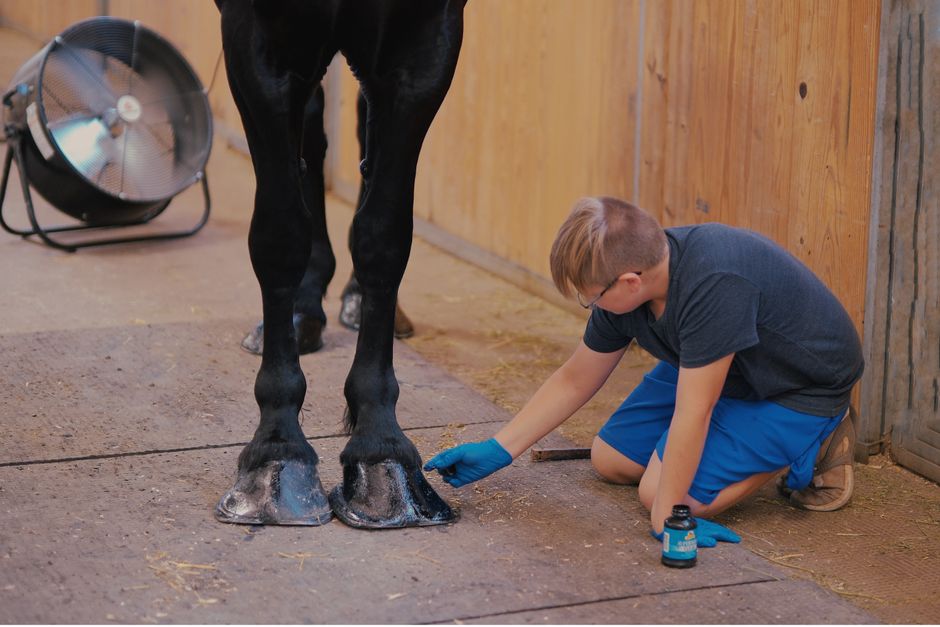
In practical barn use, Coppertox is typically painted onto the sole, frog, and sulci with a brush. Some farriers have applied it to the hoof wall, and it has even been used on abscess tracts after drainage. Its popularity grew because it was inexpensive, easy to apply, and seemed to clear up surface-level thrush quickly.
How Coppertox Works on the Hoof
Understanding why Coppertox behaves the way it does requires a basic grasp of hoof anatomy. The frog and the sulci — the grooves on either side of the frog and the central sulcus — are naturally moist, warm, and packed with organic material. That environment is ideal for the anaerobic bacteria and fungi that cause thrush.

Copper naphthenate attacks these organisms through the toxic action of copper ions, and the solvent carrier helps the compound penetrate debris. The astringent effect dries out the hoof tissue, which is why Coppertox was traditionally used on horses kept in wet, muddy conditions or stalled on urine-soaked bedding.
However, this drying action is a double-edged sword. A healthy hoof needs a degree of moisture and flexibility. Repeated or excessive use of harsh drying agents can leave the hoof wall brittle, the sole hard and unforgiving, and the frog less resilient to the concussion of movement. Overuse essentially trades one problem for another.
Legitimate Uses — and Why They Have Narrowed
Coppertox still has a documented place in veterinary medicine in 2026, but that place is smaller than many owners assume.
- Abscess tracts: Some veterinarians still recommend copper naphthenate products to pack or flush a draining hoof abscess, because the chemical environment discourages secondary infection while the tract heals.
- Severe soft-tissue infection in the foot: In rare, stubborn cases where bacteria have invaded deeper hoof structures, a veterinarian may choose a strong antiseptic as part of a broader treatment plan.
- Temporary drying in chronic wet conditions: Used sparingly and briefly, a copper-based product can help dry a persistently soggy sole.
Notice that every one of these situations is either short-term, clinical, or both. Coppertox was never designed for daily, indefinite application, and modern hoof care professionals increasingly view routine, long-term use as counterproductive. It is also worth noting that copper naphthenate products can be irritating to human skin and eyes and are toxic if swallowed, so careful handling and storage are essential, especially in barns with children or curious animals.
Why Many Professionals Now Avoid Routine Coppertox Use
The shift away from routine Coppertox use is driven by several converging concerns.

Tissue Damage and Hoof Hardness
Harsh solvents and high concentrations of copper can damage living tissue at the coronet band and in the sensitive structures just beneath the hoof. When the frog is repeatedly dried and chemically burned, it loses its natural pliability. A hardened, shrunken frog absorbs shock poorly and can actually become a site for new fissures and crevices where thrush thrives.
Resistance and Recurrence
Killing organisms shallowly without addressing the underlying conditions — deep central sulcus, poor footing, unbalanced trimming, or metabolic issues — simply invites recurrence. Many horses treated with Coppertox appear to improve for a week and then relapse, leading owners into a frustrating cycle of repeated applications.
Environmental and Safety Considerations
Copper compounds persist in soil and can be harmful to aquatic life when they wash out of paddocks or run off into waterways. In an era when barn managers are more conscious than ever of environmental impact, that persistence matters. For anyone looking to reduce chemical load in their horse's environment, natural hoof care products are increasingly the preferred first line of defense.
Better Approaches: Natural Hoof Care in 2026
Modern hoof care focuses on three pillars: mechanical correctness (a balanced trim), environmental management (clean, dry footing as much as possible), and targeted, tissue-friendly treatment of infection. Instead of bludgeoning the hoof with harsh chemicals, the goal is to support the hoof's own capacity to heal and to create conditions where thrush and canker organisms cannot flourish.
This is where natural, high-performance formulations have genuinely changed the game. Products built around ingredients that restore the hoof's natural balance, rather than strip it, allow the frog and sole to remain flexible while still resolving infection.
For horses dealing with chronic thrush, especially in the deep central sulcus where infection can sit out of reach, a dedicated treatment such as Outlaw Thrush Stuff™ for white line and severe central sulcus thrush is designed to reach the organisms without destroying the surrounding tissue. Applying it consistently while keeping the hoof clean gives the frog a chance to rebuild rather than merely dry out.
Where the hoof wall itself is dry, cracked, or brittle — a common consequence of years of aggressive drying agents — restoring flexibility becomes the priority. A nourishing conditioner like Outlaw Nourish™ natural hoof conditioner helps rebuild moisture balance and elasticity in the hoof wall, supporting the hoof as it grows out. Farriers frequently pair a treatment for infection with a conditioner for the wall, since the two problems often travel together.
For more severe proliferative conditions, including canker and advanced white line disease, stronger natural protocols are available. Outlaw Hoof Canker Care™ is formulated to address proliferative pododermatitis and severe white line involvement. In these difficult cases, it is always wise to work alongside a veterinarian, because canker in particular can require debridement and long-term management.
Professionals who treat multiple horses often stock up on treatment-sized and nourishing products together. Buying in bulk through Outlaw Horse Products wholesale is a practical way for farriers, barns, and rescues to keep effective natural hoof care on hand without paying retail each time. Horses recovering from laminitis or founder may also benefit from a comfort support such as the Outlaw Laminitis Founder Hoof Comfort Pad, which reduces pressure on painful soles during recovery.
Best Practices for Hoof Infection Treatment
Whether you are transitioning away from Coppertox or simply trying to do right by a horse with hoof trouble, a few fundamentals apply regardless of which product you choose.
- Get an accurate diagnosis. Thrush, white line disease, canker, and abscesses look similar to a casual eye but require different strategies. A veterinarian or experienced farrier should assess any hoof that is lame, bleeding, or foul-smelling for more than a few days.
- Correct the trim. Infection almost always has a mechanical component. Long toes, underrun heels, and overgrown bars create the pockets where organisms hide. No topical product replaces good farriery.
- Manage the environment. Pick stalls, provide dry turnout when possible, and address muddy, manure-packed areas. Just as human health guidelines emphasize regular movement and activity for physical wellbeing — a principle reflected in public health recommendations on physical activity — horses benefit from movement across varied, dry footing that stimulates circulation in the foot.
- Treat consistently and gently. Apply your chosen treatment according to the label or your veterinarian's instructions, cleaning the hoof first. Frequency beats force; consistent, moderate applications outperform harsh, infrequent ones.
- Support hoof quality between treatments. Balanced nutrition (biotin, zinc, copper in appropriate ratios, and quality protein), regular exercise, and a good conditioner keep hooves resilient.
- Track progress with photos. Digital photos or notes taken every two to four weeks show whether the frog is filling in, the sulcus is opening up, and the hoof wall is growing down healthier. This kind of progressive monitoring is standard practice in human fitness programming, where certified professionals rely on structured, measurable progression — see the American College of Sports Medicine for how careful programming principles work — and it applies equally well to rehabilitating a hoof.
Horse owners who want structured guidance on conditioning and exercise for horses returning to work after hoof issues can also draw on resources like fitness and exercise libraries as a conceptual model for gradual, progressive loading. The parallel is simple: tissues, whether muscle or hoof, adapt to consistent, sensible demand and break down under sudden overload or chronic abuse.
Common Mistakes to Avoid
Even well-intentioned owners make mistakes with hoof treatments. The most common is applying a strong product to a hoof that has not been thoroughly cleaned, which traps debris and organisms beneath the dressing. Another is using a drying agent on an already-brittle hoof, which worsens cracking. A third is treating only the visible problem — painting the frog while ignoring the deep central sulcus, the white line, or the heel bulbs. Finally, some owners stop treatment as soon as the smell disappears, allowing infection to rebound before healthy tissue has regrown.
Natural products are not a license for complacency. They work best when used consistently as part of a complete plan that includes proper trimming, dry footing, and, where indicated, veterinary care.
Conclusion
Coppertox occupies an interesting position in equine history: a product that solved real problems but that modern hoof care increasingly views as too harsh for routine use. In 2026, the better question is not "should I use Coppertox?" but "what is actually causing this hoof problem, and what will resolve it without damaging the tissue?" For the majority of thrush, white line, and hoof quality issues, natural, targeted treatments combined with excellent farriery and clean management produce stronger, longer-lasting results. Support the hoof's own healing capacity, treat infection precisely, and nourish the wall as it grows — that approach keeps horses sound and comfortable for the long haul.