

Table of Contents
- Signs of a Horse Hoof Abscess: What You'll See Before You Treat
- What You'll Need Before You Start Treating a Hoof Abscess
- Step 1: Locate the Abscess and Establish Drainage
- Step 2: Soaking with Epsom Salts and Applying a Poultice
- Step 3: How to Wrap a Horse Hoof After Drainage
- Step 4: Pain Management and Horse Hoof Abscess Recovery Time
- Step 5: Preventing Recurrent Hoof Abscesses
- Common Mistakes to Avoid When Treating Hoof Abscesses
- Frequently Asked Questions
Last Updated: October 3, 2026
Signs of a Horse Hoof Abscess: What You'll See Before You Treat
A horse hoof abscess is a pocket of pus trapped inside the hoof capsule and one of the most common causes of sudden, severe lameness. Outlaw Horse Products provides premium, high-performance equine hoof care solutions developed from over 40 years of hands-on experience by a Journeyman Farrier. Treating horse hoof abscesses starts with spotting the signs early.
The first clue is usually dramatic. Your horse was fine last night. This morning, he will not put weight on one leg.
Here is what you will typically see:
- Sudden, severe lameness, often in just one hoof
- A strong digital pulse felt at the back of the pastern
- Heat in the hoof wall and coronary band
- Pain when you press the sole with hoof testers
- Swelling that moves up the leg over time
A horse with an abscess often points the affected toe down, refuses to bear weight, and may sweat, breathe hard, shift constantly, or lie down more than usual.
The pain comes from pressure: pus builds inside a rigid hoof capsule with nowhere to go.
Acute vs. Chronic: How the Symptoms Differ
Acute abscesses hit fast, with lameness within hours and a strong digital pulse.
Chronic abscesses build slowly, with mild lameness that comes and goes, a dark spot on the sole, or a draining tract that never fully closes, often tracking under the hoof wall for weeks before it breaks open.
If your horse has been lame on and off for months, treat it as chronic. Those cases need a vet and a farrier working together.
What You'll Need Before You Start Treating a Hoof Abscess
Get your supplies together before you touch the hoof. A horse in pain will not stand patiently while you search the barn.
Here is your basic kit:
- Clean bucket and warm water
- Epsom salts
- Hoof pick and stiff brush
- Hoof knife and hoof tester
- Poultice pads or paste
- Self-adhesive bandage wrap
- Duct tape or a hoof boot
- Clean towels and gloves
- Vet wrap and a diaper or gauze square
Wear gloves the whole time; pus is infectious.
Step 1: Locate the Abscess and Establish Drainage
Drainage is the single most important step. Until pus can escape, the pressure and pain will not stop.
Pick the hoof clean and wash it. Look for a dark spot, soft area, or bulge in the sole, then press around the sole and white line with hoof testers. The spot that makes your horse flinch is your target.
Use a hoof knife to pare dead sole over that spot in thin slices until you find a small dark tract where pus seeps out.
Open it just enough to let the pus drain; over-paring creates a bigger wound and a longer recovery.
If the pus is under the sole, soak first to soften the tissue.
When to Call the Vet for Surgical Drainage
Call your vet if any of these apply:
- You cannot find the abscess after 24 hours of soaking
- The horse is not improving after two days of treatment
- The coronary band is bulging or the hoof wall is separating
- The horse has a high fever or refuses to eat
- You suspect a deep sole abscess or infection in the bone
A vet can use nerve blocks, X-rays, or surgical drainage to find and open the pocket. Never dig blindly into a hoof. You can damage the sensitive structures inside.
Step 2: Soaking with Epsom Salts and Applying a Poultice
Soaking draws the abscess out and softens the sole.
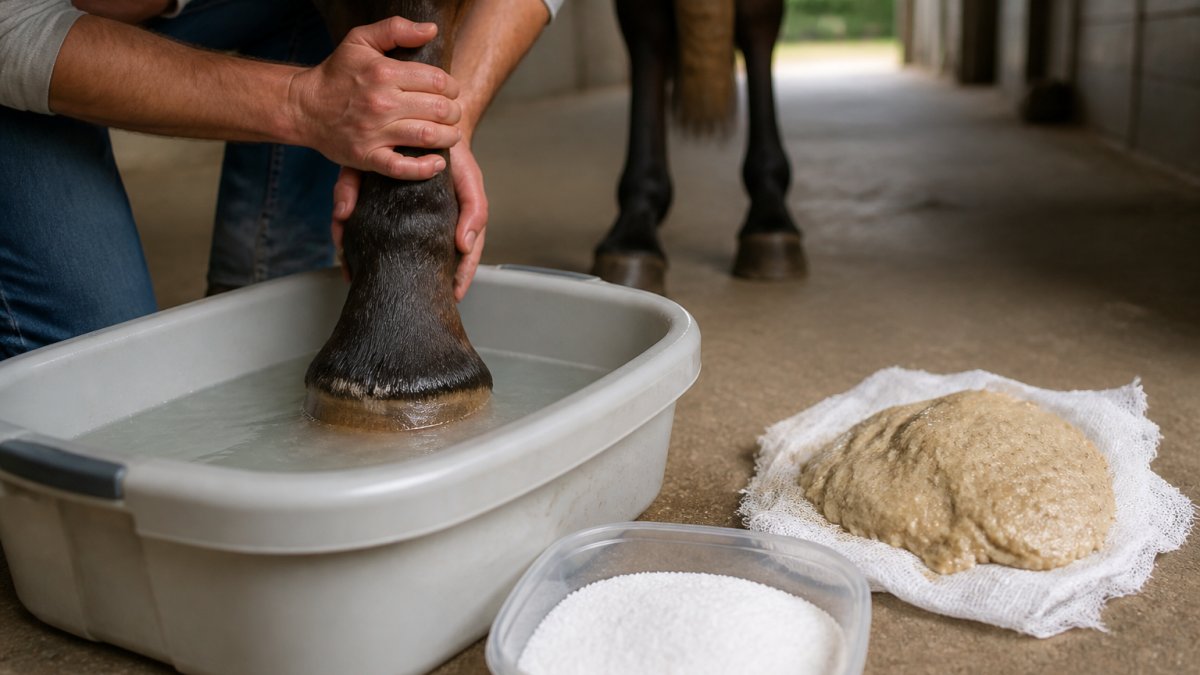
Keep the water warm, not hot, and test it with your hand first; most horses relax once the warmth eases the pressure.
After soaking, dry the hoof and apply a poultice, a moist pack that pulls remaining pus to the surface and calms inflammation, over the sole and up to the coronary band.
How to Draw an Abscess Out of a Horse's Hoof
Drawing an abscess out means encouraging pus toward the surface so it can drain; soaking and poulticing are the two main tools.
- Soak in warm Epsom salts for 15 to 20 minutes daily
- Apply a poultice pad or paste after each soak
- Wrap the hoof to hold the poultice in place
- Repeat until drainage stops and lameness fades
Most abscesses break open and drain within a few days of consistent soaking. If nothing changes after three days, call your vet.
Step 3: How to Wrap a Horse Hoof After Drainage
A good wrap holds the poultice against the sole, keeps dirt and manure out of the open drainage tract, and protects the hoof wall while the horse moves. Most treatment failures at this stage are wrap failures, not drainage failures.
Materials That Actually Work
A reliable home wrap uses four layers:
- Inner layer, poultice or gauze. A poultice pad, poultice paste on gauze, or plain gauze square sits directly over the sole and drainage hole.
- Middle layer, diaper or absorbent pad. A human infant diaper (size 1 or 2 fits most adult hooves) or thick gauze square absorbs drainage and cushions the sole; diapers are popular because the elastic leg cuffs grip the hoof wall and resist slipping.
- Binding layer, self-adherent vet wrap. A 4-inch roll of cohesive bandage (Vetrap, Co-Flex, or equivalent) holds everything in place, sticking to itself rather than hair or skin.
- Outer layer, duct tape or hoof boot. Overlapped duct tape strips form a waterproof shell; a commercial hoof boot (Easyboot, Cavallo, or similar) is faster and reusable but costs more up front.
Step-by-Step Application
- Clean and dry the hoof. Pick the sole, brush out the sulci, and blot the drainage hole dry. A wet hoof sheds wraps.
- Pack the sole. Apply poultice or gauze directly over the drainage tract, thin enough that the hoof sits flat.
- Apply the absorbent layer. Fit the diaper or gauze so the elastic or edges sit just below the coronary band, not over it.
- Wrap with vet wrap. Start at the toe, work toward the heel, then spiral up the wall, overlapping each pass by half the wrap width. Keep tension even, snug like a sock, never tight like a tourniquet.
- Stop below the coronary band. The top edge should sit at or just below the hairline; wrapping over the coronary band is the most common cause of pressure sores and swollen legs.
- Seal with duct tape or a boot. Overlap three or four strips of duct tape around the wall and across the bottom, or fit a hoof boot over the wrap.
How Often to Change the Wrap
- Every 24 hours during active drainage, or sooner if the wrap is wet, soiled, or slipped.
- Every 48 hours once drainage stops and the tract is closing.
- Continue wrapping until the sole is dry, the digital pulse is normal, and the horse is sound at a walk, usually 5 to 10 days for a typical sole abscess.
Troubleshooting Common Wrap Failures
- Wrap slips off in turnout. The diaper layer is too small, or the vet wrap was applied toe-to-heel instead of heel-to-toe. Add a second layer of duct tape across the bottom.
- Wrap soaks through in minutes. The horse is standing in mud or a wet stall. Move him to dry bedding and add a hoof boot over the duct tape.
- Horse chews the wrap off. Apply a bitter-tasting anti-chew spray to the outer duct tape, or use a boot with a secure closure.
- Leg swells above the wrap. The wrap is too tight. Remove, check for a pressure sore, and reapply with less tension.
- Foul smell under the wrap. The tract is not draining or a secondary infection has set in. Call your vet.
Step 4: Pain Management and Horse Hoof Abscess Recovery Time
Most horses improve within 48 hours of drainage. The digital pulse fades, and weight-bearing returns. Full soundness may take a week or more.
Pain relief matters during this window. Your vet may prescribe non-steroidal anti-inflammatory drugs such as phenylbutazone; never give these without veterinary guidance.
Other ways to keep your horse comfortable:
- Keep him in a clean, dry stall or small paddock
- Provide soft bedding to ease standing
- Hand-walk him gently once he is willing to move
- Check the digital pulse daily to track progress
Antibiotics are not always needed. Most abscesses drain and heal on their own. Your vet will decide if antibiotics or tetanus prophylaxis are warranted.
Step 5: Preventing Recurrent Hoof Abscesses
Most owners treat an abscess, breathe a sigh of relief, and go back to business as usual, then it happens again three months later. Recurrence is almost never bad luck but a predictable result of the same conditions that caused the first abscess. Fixing those conditions is the difference between one abscess and a chronic problem.
Environmental Management: The Piece Most Guides Skip
Bacteria that cause hoof abscesses need two things: a break in the hoof's defenses and a wet, dirty environment. You cannot always control the break, but you can control the environment.
Stall hygiene.
- Strip and rebed stalls daily during wet seasons; ammonia from urine softens the sole and white line faster than mud.
- Use absorbent bedding (pelleted wood, shavings, or straw) at least 3 to 4 inches deep so the hoof never stands in moisture.
- Scrape and re-level stall floors monthly; low spots collect urine and create permanent wet zones.
Paddock and turnout conditions.
- Fix wet zones first, gateways, water troughs, run-in sheds, where horses stand the longest.
- Add gravel, crushed stone, or rubber mats to high-traffic areas so hooves stay out of standing water.
- Rotate turnout when possible; a week to dry between uses dramatically reduces exposure.
- Avoid turnout in deep mud during freeze-thaw cycles; frozen ruts cut the sole and create entry points.
A common pattern: horses that get repeated winter abscesses almost always live in paddocks with a wet gateway or a run-in shed that never dries out. Fix the gateway and the abscesses usually stop.
Post-Abscess Hoof Wall Integrity: Managing the Hole
When an abscess ruptures, at the sole, white line, or coronary band, it leaves a defect that stays a weak point until the hoof grows past it. Most guides stop at "the abscess drained, you're done." That is where the next abscess starts.
What to do after drainage stops:
- Keep the tract clean until it closes. Flush with dilute chlorhexidine or betadine once daily for the first few days, then taper off as the tissue seals.
- Do not pick at the defect. Paring the edges of a healing tract reopens the wound and delays closure.
- Protect the defect during turnout. A hoof boot or light wrap over the sole keeps dirt out while tissue is soft.
- Watch for a coronary band defect. Ruptures at the coronary band leave a visible notch that grows down at roughly 1 cm per month, reaching the ground in 8 to 12 months. Until then, the wall is thinner and prone to cracking.
- Support wall strength. A hoof conditioner on the wall and coronary band keeps new growth flexible; avoid harsh drying agents (some thrush treatments) on a healing wall.
Trim Schedule and Farrier Coordination
- Trim every 6 to 8 weeks. Long toes and unbalanced walls stress the white line and create separation.
- Ask your farrier about breakover. A rolled or squared toe reduces leverage on the wall and lowers the risk of cracks.
- Address white line disease early. A stretched or seedy white line is a highway for bacteria; your farrier can pare it out before it becomes an abscess.
- Shoe or barefoot, either can work. The right choice depends on workload and hoof quality; what matters is balance, not the shoe itself.
Daily Checks That Catch Problems Early
- Pick hooves daily and look at the sole, frog, and white line.
- Feel for heat in the hoof wall and coronary band.
- Check the digital pulse at the back of the pastern, a strong pulse on a sound horse is an early warning.
- Note any change in gait, even subtle; horses hide lameness until the pressure builds.
Prevention is not a single product or fix. It is dry footing, a consistent trim schedule, and attention to the hoof wall after every abscess. Get those three right and most horses stop getting abscesses altogether.
Common Mistakes to Avoid When Treating Hoof Abscesses
Most treatment failures come from a handful of avoidable mistakes:
- Digging too deep. You can damage the sensitive sole and cause a worse infection.
- Skipping the soak. Dry poulticing does not draw pus out as well as a warm soak.
- Wrapping too tight. A tight wrap cuts circulation and can cripple a horse.
- Stopping too soon. Keep soaking and wrapping until drainage fully stops.
- Ignoring a chronic case. A two-year abscess problem needs a vet and a farrier, not more of the same.
- Turning out in mud. A clean, dry space is part of the treatment, not a luxury.
At Outlaw Horse Products, we built our hoof care line around these lessons. Our natural, chemical-free formulas combat thrush, canker, and abscesses while supporting healthy tissue regrowth. A Master Farrier with more than 40 years of experience developed them, and professionals who work on hooves every day trust them.
If your horse keeps fighting the same abscess, the fix is often a stronger, better-hydrated hoof, where a good conditioner and a dry, clean environment do the most work.
For hoof care guidance from the people who have handled thousands of abscesses, see the American Association of Equine Practitioners owner resources and the American Farriers Association hoof care guidance. Both offer practical help for owners working through lameness cases.
A horse that keeps coming back lame with the same abscess is telling you something. The hoof needs more than a one-time fix. It needs strong tissue, dry footing, and consistent care.
Frequently Asked Questions
How can I treat a hoof abscess on my horse at home?
Start by confirming the signs: heat, a strong digital pulse, and sudden lameness. Soak the hoof in warm water with Epsom salts for 15 to 20 minutes once or twice daily to soften the sole and encourage drainage. Apply a poultice to draw pus toward the surface, then wrap the hoof with a diaper, vet wrap, and duct tape. If the horse is not weight-bearing after 48 hours or you see swelling up the leg, call your veterinarian.
Can a hoof abscess heal on its own?
Some abscesses rupture at the coronary band or sole and drain without intervention, but leaving one untreated risks infection spreading into deeper structures. A horse that is three-legged lame needs immediate veterinary attention. Even when an abscess appears to resolve, the hoof wall and sole often need ongoing care to restore strength and flexibility. Check the hoof daily for a draining tract and keep the area clean until it closes.
What is the best poultice to draw out a horse hoof abscess?
A poultice made from Epsom salt paste, ichthammol, or a commercial drawing agent works well when packed into the sole and covered with a pad. The goal is to keep the sole moist and warm so the abscess finds the path of least resistance. Pair the poultice with soaking for the best results. Natural, non-irritating formulas are a good choice for horses with sensitive frogs or those in wet conditions.
When should I call a vet for a horse hoof abscess?
Call your veterinarian if the horse has been lame for more than 48 hours, is not bearing weight, has swelling above the fetlock, or shows a fever. A vet can use hoof testers to pinpoint the abscess, perform surgical drainage if needed, and prescribe non-steroidal anti-inflammatory drugs for pain relief. Tetanus prophylaxis may also be recommended if the hoof wall is compromised.